

Interactive Print: How Augmented Reality Is Reshaping Direct Mail
Businesses today can reach people through more communication and marketing channels than ever before, from email and text messaging to social media and search marketing. They’re spoilt for choice. So where does print and direct mail fit in? What has been the impact on it, and is it still a relevant communication and marketing channel?
The Impact of Digital on Direct Mail
US Postal Service (USPS) mail volume peaked at 213 billion units in 2006 and has since fallen to 129 billion (USPS table facts). Online account statements and paperless billing have been named as the main reasons for the decline. Businesses cutting costs and switching to digital substitutes has clearly affected mail volume. In the UK, Royal Mail reported delivering on average around one letter per household a day, a drop of around 22% over the five years to 2019/20. But the British company’s fortunes turned last year, when the pandemic boosted its 2020-21 profit by 116% (Reuters).
That may look like a grim outlook for direct mail, but don’t be fooled. Fewer pieces doesn’t mean direct mail is in decline. With fewer pieces in mailboxes there’s less clutter, and marketers know it. Opening the mailbox is a different experience now, and so is how people feel about getting mail. Because there’s less of it than there was a decade ago, 57% of people say receiving mail actually makes them feel more valued. A brand that sends mail is seen as building a more genuine relationship with the consumer. The Royal Mail MarketReach paper says the same, with 70% saying mail gives recipients a better impression of the organisation (up from 55% in 2013).
Direct Mail ROI

Interactive Print: Augmented Reality can turn a simple postcard into a measurable, powerful and exciting marketing tool.
At 29%, direct mail has the third-highest marketing ROI, after email marketing at 124% and social media at 30%. Direct mail did better than popular digital channels such as paid search, which recorded a marketing ROI of 24%, and online display at 16% (DMA Response Rate Report). According to the USPS Customer & Market Insights, 50% of consumers have tried a new product, service or establishment in the past six months after getting a direct mail advertisement. The average household gets only two pieces of direct mail a day, against 157 emails, which makes direct mail a powerful communication channel with less noise. Even though they’re called the digital generation, Keypoint Intelligence-InfoTrends found millennials to be the demographic most likely to engage often with a mailpiece. And millennials have overtaken Baby Boomers as America’s largest generation at 72.12 million (Pewreseach.org). That makes them the largest generation in the world’s future.
Augmented Reality and Direct Mail, the New Power Combo
Augmented reality has come a long way since Harvard professor and computer scientist Ivan Sutherland first invented it in 1968. Yes, the 60s. But it was the launch of Pokémon Go in July 2016 (Harvard Business Review) that really introduced the global population to Augmented Reality. Overnight, 45 million users discovered the concept.
Brands have since found that Augmented Reality is an extremely powerful communication and marketing tool. BMW and Audi have used AR to give customers true-to-scale, three-dimensional views of car models based on customised features such as paint color, wheel design and interior finish. Lego has created a whole new way to play with a companion AR app that brings Lego characters to life (Science Daily).

Interactive Print: AR turns this regular brochure into an interactive tool that gives customers an immersive experience and also sends them to the website.
With less clutter in mailboxes and AR on the rise, businesses in many industries are adding digital elements to direct mail. Direct mail now even has a new category: AR-enabled Direct Mail. It has never been easier to design an AR-enabled direct mail campaign. There are plenty of AR platforms that are easy to use, even for beginners or companies with small marketing budgets. Augmented Reality company Orpington Omni Media, for example, lets its users create a campaign within minutes. All you do is upload artwork and the matching video or 3D animation, and the campaign is ready to launch.
Leading Postal Services Are Already Adopting AR-Enabled Direct Mail (Interactive Print)
Forward-thinking postal service organisations are moving into digital territory and using integrated digital technologies such as Augmented Reality. In America, USPS launched Irresistible Mail, which included bespoke augmented reality enabled direct mail and print solutions. It followed that with Informed Delivery, a platform that lets customers see and interact with a digital preview of their incoming direct mail.
In 2019, Royal Mail launched an Augmented Reality (AR) parcel sizer in the UK as part of the latest update to the Royal Mail App. The parcel sizer helps users find the right format size and price for their item and then buy postage directly in the App. A spokesperson for Royal Mail said, “The new features of the Royal Mail App are part of our commitment to investing in technology that improves the customer experience for both senders and recipients.”
Both USPS and Royal Mail clearly recognise the benefits of bringing technologies such as AR to direct mail, and they actively promote them to encourage customers to adopt them and improve their direct mail performance and results. Ryan Kiley, director, Strategic Production Services, Commercial & Industrial Printing Business Group at Ricoh USA, notes that in 2016 USPS drove more than 13.5 billion mail pieces that took advantage of AR promotions. “When AR was incorporated [into marketing campaigns], response rates jumped from 2-3% to 35%,” Kiley says (Pi World).
What’s Old Is New Again: AR-Enabled Direct Mail
AR can bring print material to life, and that’s what we call Interactive Print, or making print AR-enabled. Interactive Print (AR) takes printed collateral further by adding immersive, interactive content. Communication and marketing materials such as direct mail pair perfectly with AR. Print and AR once seemed to belong to separate worlds. Today AR is what makes print and direct mail the new hero in omnichannel marketing. So how does it work?
The basic idea is that anything you can print with a QR code linking to a predetermined web URL can be AR-enabled. Direct mail, brochures, press adverts, booklets and signage are all easy to AR-enable and transform with interactive print. AR-enabling your print collateral also gives your print marketing new capabilities: tracking campaign performance, improving engagement, setting predefined customer journeys and even building a smooth bridge to digital platforms. Suddenly the results of direct mail can be defined and tracked. AR-enabled direct mail lets marketers measure many metrics on consumer engagement and on the performance of print-to-digital campaigns, and add tracking codes for use across other channels.
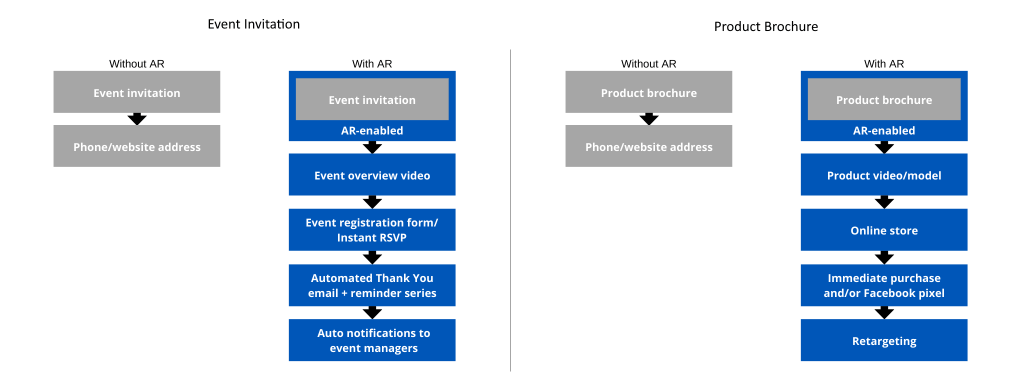
Example: AR-enabled omnichannel workflows for Direct Mail.
Interactive Print/AR-Enabled Direct Mail Ideas
Here are a few ways you can use Augmented Reality in Direct Mail:
- AR enabled postcards
- AR enabled envelopes
- AR-enabled product brochures and catalogues
- AR-enabled event invitations
- AR-enabled fridge magnets and calendars that can show different promotional content each time they’re scanned
- AR-enabled political mail
- AR-enabled flyers (e.g. property listings and open homes).
In a competitive market, brands, printers and mail service providers need to make use of these digital assets to build an approach that is truly omnichannel. Augmented Reality can be what sets a brand apart from its competitors and keeps it recognized. Direct mail is hardly an outdated marketing tactic, and with the power of AR it’s more relevant than ever.
—